Showing posts with label Up-To-Date. Show all posts

Wednesday, 16 October 2013

Wheel & Tyre Care

Wheel & Tyre Care


Maintenance of painted, anodized and clear-coated aluminum   wheels is not much different than cleaning body paint.

Wheels pickup alot of road grit and abrasives which could scratch your paint. Wheel Arches are the inner area that surrounds the wheels & tyres and so any dirt and comtaiments picked up from the road surface by will be deposited on them quickly too. As well as pickig up dirt from the road 

The wheels get covered and with in the arch itself and these will work better and last longer if kept free from the build up of harmful containments.

Tyres also pickup and carry all the same dirt & containments that the wheels do. It is impotant to properly clean and dress your tyres as this helps to prevent the tyre walls from fading, cracking and degrading due to the sun and water from the road surface.

So a strong alkaline based wheel/tyre cleaner is needed to break the bond between dirt, tar, brakedust and wheels to creep under the surface to loose the dirt. When caring for your wheels it is important that you have the proper products and tools. We recommend maintaining your wheels with a Automotive wash cleaner and water with a dedicated wash mitt, every time you clean your vehicle (1 to 2 weeks). Thorough cleaning of your wheels and adding layer(s) of protection should be done every 2 to 3 months. It is also important to know what type of wheels you have so you use the proper products on them. If you have factory alloy wheels, chances are they have a layer of clear coat on your wheels. This makes things easy because you can use a variety of wheel cleaners without worrying about oxidizing your wheels finish. You can also treat them like you would your clear coat on your paint, which means you can wash clay, polish and protect your wheels.

Some wheels need extra cleaning power such as chrome wheels and those made of roughcast metals. In this case, strong cleaners like Mothers® Foaming Wheel&Tire Cleaner can be employed. Take extra care to prevent the cleaner from coming into contact with other parts of the car, and don't let it sit too long before hosing off. Be sure your wheels are chrome or roughcast, because Chrome Wheel Cleaner can damage clear-coated and painted wheels. When doing chrome wheels, you can chase the cleaner with a chrome polish to properly finish the job..

Your wheels should be completely cool when you start to clean them. If you have been out driving, even just a little bit, give them ample time to cool down before using any cleaner on them. You can spray them down with water to help them cool down but it may take some additional time for them to reach air temperature so you can begin cleaning. Clean the wheels in the shade whenever possible to avoid water marks or rinse them frequently while in direct sunlight.

Polish:

Polishing your wheels can help increase the depth and gloss of your wheels as well as remove minor surface imperfections. If your wheels have a clear coat on them, then you can treat them the same as you would polishing your paint. If your wheels consist of bare metal, such as the lip of your wheel, you can polish them using a metal polish to increase gloss and depth and remove minor imperfections.

Recomended Products: http://www.autofresh.in/home-wheel-tire-care

Leather Care

About Leather Care


Leathers are made of animal skin. Leathers are breathable, nondurable.

Mainly protected/Topcoated leather comes in super luxury cars. This is the most common leather type and is issued in over 95% of interiors. The leather has a uniform appearance and color with a definate pattern(grain).

You cannot see any natural leather markings through the top coatings because a pigmented leather paint coat is applied to the surface. It is then sealed with adurable finish. If properly maintaines this finish will provide years of durability, Identofying chatecteristics of pigmented/Painted leather: uniform color and grain patterns will not scratch easily, water dropped on to the surface will not change the color of the leather.

Their enemies are dirt, dust, oil & sweat from the human body.This will cause leather to brake down, age and discolor surfaces. Detergents will damage and leather by dissolvingy the the protective coating causing the material to prematurely lose its sheen, dry and crack.

To prevent this happening always use a mild NON-Solvent based cleaner to clean the leather to avoid discoloration from any chemical containment.

How To Care:

    Leather can be virtually indestructible if treated properly. With a little bit of care and attention, your new leather will last well into vintage age and your vintage leather will continue to have a long happy life. Improper care or cleaning can crack and dry leather skins, removes finishes and colors. Keeping leather away from chemicals, heat, and humidity are key. If leather is like skin, think of its care as anti-aging; if you wouldn't put it on your own skin, it probably isn't very good for the leather either.
    choose a leather conditioner that is solvent-free, because it will penetrate deeply and won’t evaporate – which means you won’t have to reapply as frequently. To take best care to your leather, Neutral pH makes it mild and it’s safe to skins or leather and will keep the leather supple and shiny.
    The most important things to remember about leather is not to get it soiled, soaked, or let it dry out. Despite the fact that all of these things can be rectified to some extent, it is helpful to not let leather get into such a condition in the first place. Proper storage, cleaning, and conditioning will keep leather looking as good as new no matter how old it is.

In general products that clean and condition in one bottle are not as effective as a separate cleaner and conditioner. The trade off with using separate products is that it can cost more and they may take more time to apply. If interested in just a leather cleaner we recommend the Leatherique Prestine Clean & Mothers Leather Cleaner.

For conditioning, Meguiar's Gold Class Leather Sealer Treatment. Leatherique Rejuvenator Oil , Insta Finish Leather Conditioner & Restorer &, Mothers Leather Coditioner.. If you want to clean and condition in one bottle the Meguiars Leather Cleaner& Conditioner  The choice is yours.

Recomended Products: http://www.autofresh.in/home-interior-car-care-leather-care


Friday, 7 June 2013

Monsoon Car Care Tips


Ask your mechanic the reason for a fault in your car, and he will give you a dozen possibilities. Your car not starting could be attributed to any number of reasons from a cold battery to a clog in the carburetor.
The phrase "Prevention is better than Cure" is most apt when it comes to car care, and even more so during the rains, when a minor fault could translate into more than just loss of time.

Nobody knows your car better than yourself. It is important that you report the right symptoms to your mechanic. While you are driving your car be alert for:

aUnusual sounds, odours, leaks, smoke, warning lights, gauge readings. 
aChanges in acceleration, engine performance, mileage, fluid levels. 
aProblems in handling, braking, steering, vibrations. 
aScratches, bubbles etc. on the paint 


The Monsoon Car Check : 

The modern car is made up of thousands of parts, any of which are liable to fail. A breakdown at best could mean a little discomfort, and at worst can create a potentially hazardous situation. While a breakdown is far from welcome at any time of the year, the consequences of a minor default can be magnified during the monsoons. A complete checkup and servicing of your car at the onset of the monsoon season is highly advisable

Given below are some of the 10 most common causes of breakdowns and accidents, which your pre-monsoon service should definitely check out for:

1. Worn Brake Parts 
2. Bald Tyres or tires with inadequate pressure 
3. Corroded Battery cable terminals 
4. Clogged Filters 
5. Worn Spark Plugs
6. Burned Out Lights
7. Loose Belts & Rotten Hoses 
8. Inadequate fluid levels - oils and coolants
9. Neglected Cooling System. 
10. Windshield Wiper Blades 

Rust :

Your car body is always has a propensity to rust due to the humidity present in the air (especially for those who stay near the coastal areas). The car-paint and finish play the very important role of protecting your car from the elements. Rain contains dirt and pollutants from the air (commonly referred to as acid rain) which can damage the finish on your car. After acid rain falls on your vehicle, the water evaporates, evaporates, leaving a film of acid on the car body. This acid can become so strong that it can "eat" through your car's finish, exposing the body underneath to rust. Some simple precautions you can take against rust: 

a) Do not neglect the daily wash of your car (especially in the monsoons). After a shower wash your car with clean tap water to remove the acid and dirt particles stuck on to your car.)


b)
 Waxing is a very effective way of protecting your car from the rains. It is highly recommended that you get your car waxed from before the rain starts and then regularly (atleast once a month) during the entire monsoon season.

c)
 The underside of your car is especially prone to rusting, since it is exposed to the water and dirt thrown by the wheels. There are several rust-protective products available in the market, which can be used on the more rust-prone parts of your car.

d)
 Keep a regular check - on the metal panels under the doors, around the wheels, in the trunk and the undercarriage of the car, as these parts are more liable to rust.

e)
 Do not neglect small scratches and nicks on the paint of your car body, since these expose the body to the rain, leaving the areas prone to rusting.


Interiors :
 Wet interiors can mean more than uncomfortable travel and smelly cars. Damp carpets & trims can cause your car-body to rust. As far as possible try to keep the interiors of your car dry. 
It is advisable that to entirely remove the carpets for the monsoons, and make do only with rubber mats & Plastic mats. Keep your clean & fresh. Always clean your car with some good interior cleaners. Use a car air freshener to clear out the smell. Also ensure that the rear wiper and heater are working right. Check and double check all the lights. Place your feet on the pedal and check if you have an adequate grip on the pedal. Your feet might slip if the pedal doesn’t provide adequate slip. Be sure to replace the pedals if you suspect a loose grip. Check the insulation of your car - rubber beadings on the doors and windows. 

If they appear loose or damaged tighten or change them. The condition of the beadings is crucial as they stop the rain from getting into the car, preventing rust and short-circuits.
Another hugely neglected item in a car's kit is safety tools - first-aid, basic medicines, torches, and umbrella etc.

 Windshield Wipers

a.) Cracks in the wipe edge, resulting in streaks on the glass which obscure vision
b.)
 Prevent the wiper to "lay over" as it changes direction across the glass, resulting in an annoying noise and an inadequate wipe.
c.)
 Prevent consistent contact with the glass resulting in un wiped regions.
Use plenty of windshield washer solvent, to get rid of stubborn dirt and prevent the windshield from getting scratched. Ensure that the arms of the windshield are properly set, so that there is no gap between the blade and the glass.

Dirty water splattered on your windshield is a common complaint during the monsoons.
 Mud flaps not only ensure that you do not cause any discomfort to other motorists (especially two-wheelers), but to an extent also protects the underside of your car from dirty water. Ensure that your car has mud flaps on all tyres. 

Car Covers

If your car is always parked outdoors (as most cars are), car-covers can afford protection from the harsh Indian sunlight, accidental scratches that could be caused by anything from dirt particles to naughty children, bird-dropping and - during the monsoon - from acid rain. However it is very important to select the right cover for your car, since a badly designed one will do you more harm than good.
 
Some precautions that you should take when using car-covers are: 
1).If the cover is too loose, the wind may constantly cause it to rub against the body, and scratch the paint.
2).If the car is not clean, the dirt particles on the car can scratch the paint while putting and removing the car cover.
3).Many times makeshift covers are used, which are actually nothing but crude plastic sheets. While these may keep the rain off your car, it traps the moisture between the cover and the body, which can cause damage to the car-paint.
 
4).While removing or putting the cover, roll it on or off the car rather than dragging it over the body, to prevent the cover from scratching the car paint.
 

While buying your car-cover:

a.)
 Make sure that the cover has a bottom locking system to hold the bottom of the cover tightly. This will help prevent wind movement of the cover and thieves from taking a casual peek. 
b.)
 While the cover material should be water-resistant, it should also be "breathable", so that it allows air to circulate, preventing condensation.
Tyres :

ken5032500k3.jpg.db5988a80b.999x275x275.jpgSeeing that your tyres are in proper condition is a very important part of preparing your car for the monsoon. Two aspects to be kept in mind while checking your tyres are:
 the tread, and the tyre pressure. 

The
 "tread" is very important for your tyre to be able to grip the road properly. Completely smooth and "bald" tyres create a vacuum between the tyre and the ground. The grooves in the tyre allow circulation of air, preventing formation of the vacuum, and allowing for a proper grip of the road. The grooves allow water to slip out, and prevent a layer from being formed between the tyre and the ground. The ideal tread depth should be at least 1 cm.Thus while you need to ensure that your tyres are in proper condition at all times, it is absolutely essential to do so during the monsoons, when the roads are wet.

Incorrect
 pressure can cause tyres to wear out much faster and the car to consume more fuel. Most importantly, however, tyres with incorrect pressure could create hazardous driving conditions, causing blowouts, skidding and handling problems. 
Take these simple precautions while filling air in your tyres: 

a)
 Strictly follow the pressures recommended by the vehicle manufacturers. Never inflate a tyre beyond its maximum rating.
b)
 You could use your own portable pressure gauge which is small, convenient and fairly accurate.
c)
 The air-pressure should be ideally checked when tyres are cold (i.e. less than 2 kilometers of driving), since tyres that have been driven for sometime build up heat inside, and will show incorrect pressure. 
d)
 Check your tyre-pressure at least once every fortnight. 

Brakes :

Your
 car brakes along with the tyres are the two most important checks of your pre-monsoon service. The brake-fluid is hygroscopic (absorbs water). Presence of moisture in the fluid can substantially lower its boiling point, which can lead to improper functioning of the brakes. The best indication of the condition of your brakes is the "play" or "feel" of the pedal. 
The brakes pedal should be hard, and travel should be restricted to a maximum of 50%. If the travel is excessive it means that the brake fluid has worn out or there are air-bubbles in the fluid. Thus either the entire fluid either needs to be replaced or the air in the system will have to be removed.
Another indication of the condition of your brakes is unusual noises. When you pump the brake pedal, friction from the brake lining causes heat. Under extreme conditions this can damage the pads and/or lining, brake drums and rotors. A metallic grinding sound indicates your brake pads are worn through. Metal-to-metal contact will damage drums or rotors.
 
If your car pulls to one side when you brake, it indicates worn or uneven brake linings or a leak in one of brake lines. Brakes that are out of adjustment or have contaminated fluid can cause brakes to drag.
 

The following checks should be made during your pre-monsoon service:
 

Master Cylinder
 - The brake fluid is stored in the master cylinder, which should be checked regularly to ensure proper fluid level. 
Brake Lines
 - are the steel tubes, which connect the master cylinder to all the four wheels. Brake lines should be inspected for rust, which can lead to leaks. If the lines are damaged they should be replaced.
Brake Hoses
 - run from the brake lines to the brake calipers and wheel cylinders. The hoses should be checked for brittleness and cracks, which could also lead to brake-failure.
Linings and Pads
 - The pads and brake shoe linings should be checked periodically for uneven or excess wear, glazing, or saturation from brake fluid or grease. 
Calipers and Wheel Cylinders
 - Brakes are activated by brake fluid pressure from the master cylinder pushing a piston located in the caliper or wheel cylinder against the pad or shoe. A leak can cause erratic braking or brake failure. 
Bearings and Seals
 - Wheel bearings should be inspected and lubricated periodically. Worn wheel bearings, can cause erratic braking, and should be replaced. 
Conclusion:
The toughest time for driving cars in India, is during the monsoon season, especially in the city. Even if we follow all rules, regulations and tips, there is always an element of risk involved in driving and maintenance of vehicles. The above tips should allow you to at least minimize that.
But always ensure to use your best judgment at all times, and remember, better be safe than sorry!
We have covered several ideas for safer driving and maintenance of car. Still, there can always be more ideas for safer driving and maintenance of cars. We welcome our readers to share their experience on how they handled their car in past and present monsoon seasons.

Monday, 31 December 2012

Waterless Wash Tips


Waterless Wash Tips 


This is the perfect step to use a day or two after a wash when there is simply a layer of light dust on your paint. Waterless wash options  are simple, quick and effective. These products are like quick detailers, loaded with cleaners and surfactants to help remove  light contamination without marring your finish.

Our two most popular products are Meguiar's Quick Detailer & IF Waterless  Wash.


They are best used with microfiber towels.
Please know that this does not replace traditional washes. On heavily contaminated vehicles, you will add marring and swirls to the finish, waterless washes are designed to remove a layer of light dust safely.

Waterless Wash How-To

Step 1: Mist the waterless wash product onto the surface you are  trying to clean
Step 2: Let product dwell for 30 seconds to a couple of minutes
Step 3: Using a clean microfiber towel, gently wipe the surface clean
Step 4: Using a second microfiber towel, buff away any streaks
Step 5: Repeat steps 1 - 4 until the entire vehicle has been cleaned

Note: For added lubricity, you can mist the microfiber towel prior to wiping the dusty surface.

Eagle One Wax-As-U Dry

Eagle One Superior Nanowax Spray

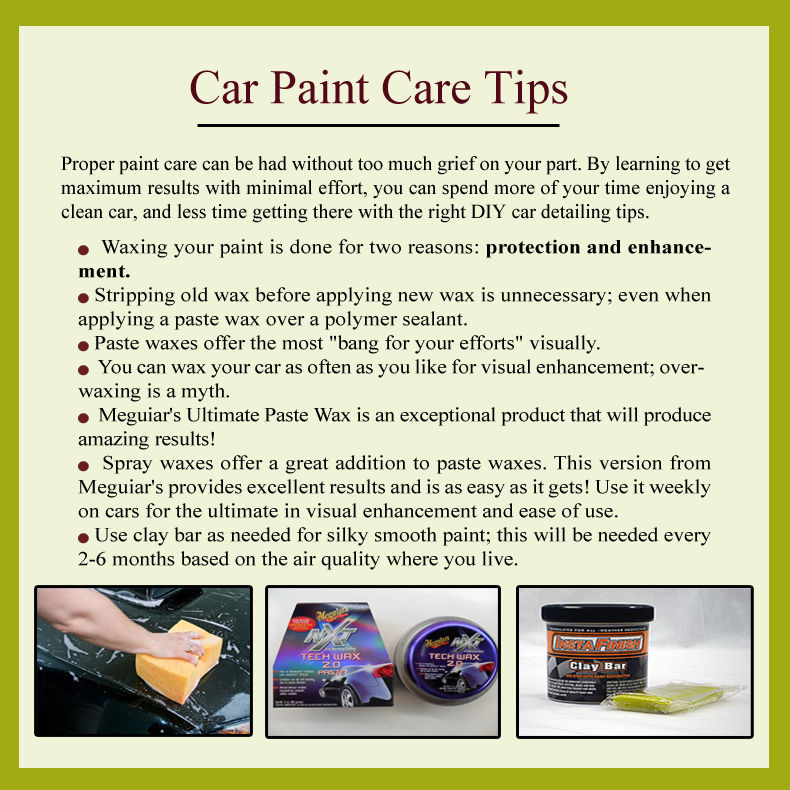
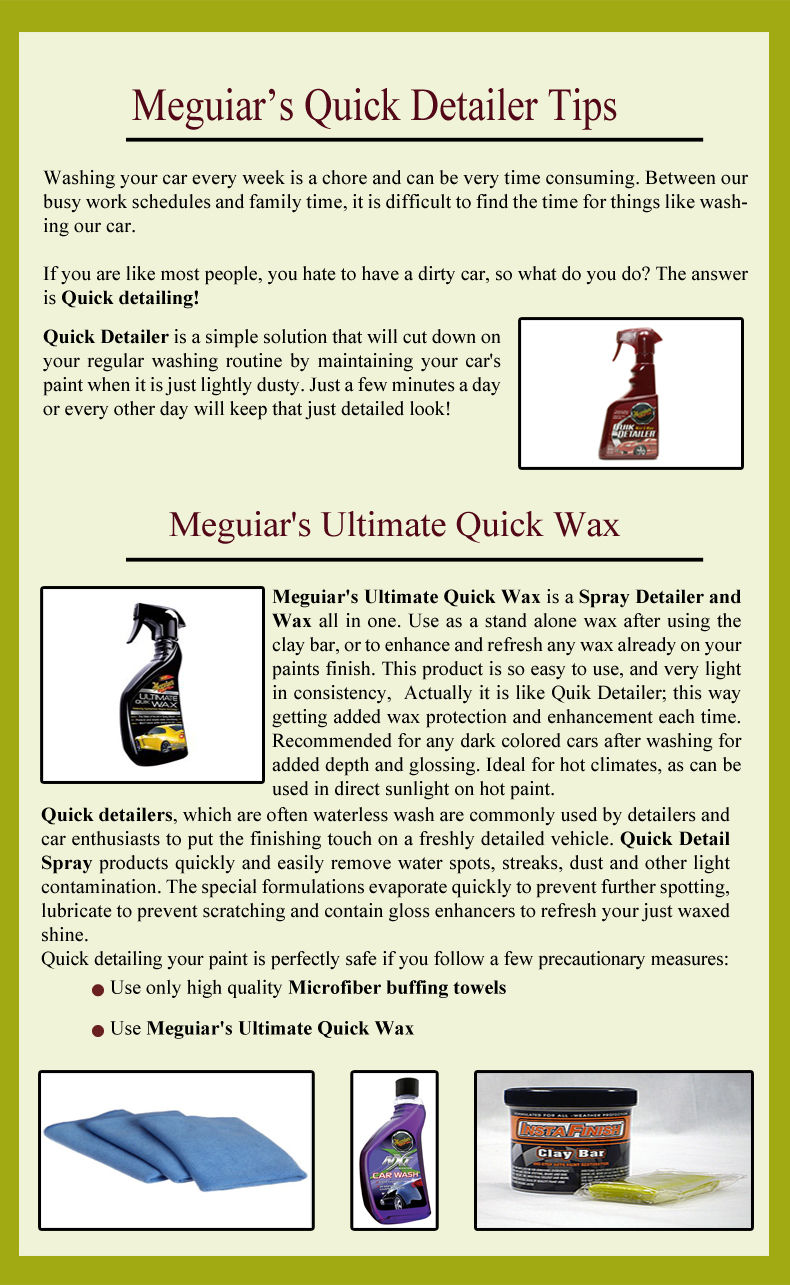
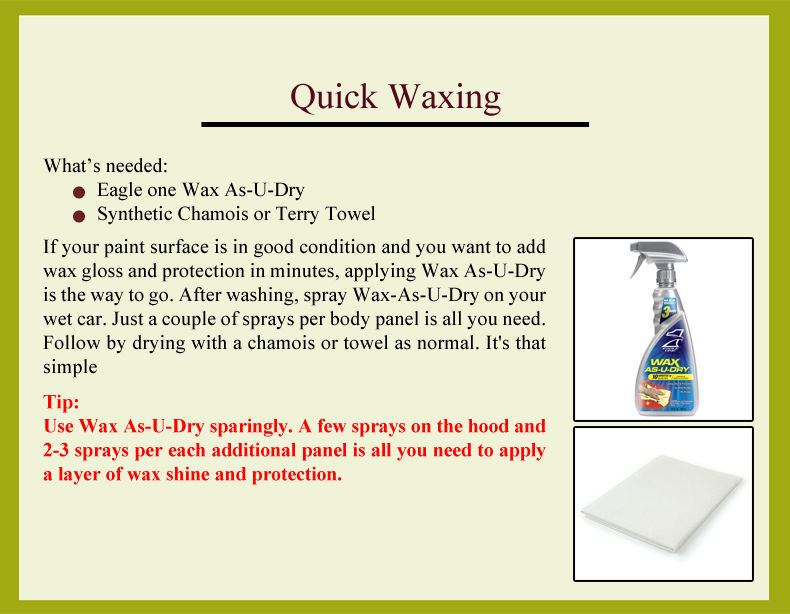
Car Paint Care Tips


Meguiar's Quick Detailer Tips


Quick Waxing


Polishing Pads care


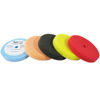
We recommend not to over saturate the pad with product. A little product goes a long way when polishing with Microfiber pads. Apply a small amount of product in circular or cross patterns on the pad surface for even coverage. Set polisher to a low or moderate speed and begin to polish the paint surface. We recommend a moderate pressure and an even coverage on a 2' x 2' section until desired results are achieved. 
The product should be worked into the painted surface until only a light haze of product is remaining. When the pad surface becomes dry, lightly spur it using the DA Microfiber Pad Conditioning Brush. This will clean the excess of dried product from the pad and revitalize the fibers. Reapply a light amount of product and repeat the same steps on other sections on your vehicle. When your pad becomes loaded with an abundance of dried product or becomes visibly over-saturated, it is time to switch the pad with a clean one.
You should not use the soiled pad again until it is washed and dried. It is very important that you do not over saturate the pad surface with product, as there is no need for this. More product and higher speeds do not create better or faster results. Over saturating the pad or polishing at a high speed may result in less favorable performance like product splattering, wobbling from uneven weight distribution or possibly even pad failure. A new, strong laminate has been used to adhere the Velcro backing to the foam. However, the pads should not be abused with improper user methods. For best results follow the above instructions and you will be amazed

Reasons to Polish your Car's Paint


Many people believe that cars come off the assembly line with perfect paint.  That's far from the case.  There are many conditions that cause minor paint flaws requiring additional finishing work.  Dust nibs (small particles that land in the paint while it is still wet) are a good example.  Most car manufacturers take care of these problems at the factory using abrasive finishing materials.  Sometimes it is the car dealer who recognizes the flaw and fixes it.

Repairing minor paint flaws through polishing is not harmful to the paint system unless you remove too much paint.  If more than 50% of the clear coat finish is removed, you stand a good chance of premature paint system failure.  If more than 75% of the clear coat finish is removed, you will experience immediate paint system failure.  It can be a very fine dance between success and failure.

Here's a general rule to follow.  If a scratch or other flaw can be felt with your fingernail, it's too deep to be completely removed through polishing.  That's not to say that polishing won't help hide the flaw; it will.  Take a look at the diagram showing paint layers and minor scratches (marring) in the clear coat surface.  These scratches can be removed completely through polishing, because more than 50% of the clear coat would remain.

Non-clear coat finishes have the same basic rules.  You should not remove more than 50% of the top coat (color coat) finish when repairing a scratch or other paint flaws.

It is important to understand how a polish can be used to "hide"  scratches and other micro marring.  In the two diagrams above, you can see that the scratches have hard edges that run at a 30 to 60 degree downward slope.  It is the hard edge and angle of a scratch that creates a perfect opportunity for light reflection.  It is this reflection that enhances the visibility of the scratch.  A good Polish rounds the edges of scratches, reducing reflection.

Here is a list of problems that can be fixed or improved through abrasive polishing:


Scratches - Surface abrasions that do not extend past the first 25% of top coat material can be fully repaired by polishing.  Deeper scratches can be improved as long as they do not fully penetrate the color coat into the primer.

Scuffs and rub marks - Scuffs are broad, shallow surface abrasions that are easily repaired by polishing.  Rub marks are commonly caused by shoe heels (getting in and out of the car) or the bumpers of other cars.  The rub mark is generally a transfer of rubber or other vinyl material to the paint surface.  Rub marks are easily removed by compounding and polishing.

Micro marring - Micro marring, also known as swirl marks and spider webbing, means very small scratches in the paint's surface.  Micro marring is created by machine compounding and in everyday use and maintenance of the vehicle.  Micro marring is easily removed by compounding and polishing.
Etching - Paint etching is a common problem caused by hard water (tap water) or acidic water (acid rain).  Bird droppings are another common cause of paint etching.  Depending on the severity of the etching, polishing will repair or lessen the appearance of etched spots.
Dust nibs - Small particles of dust and other foreign material that land on the paint during the painting process create small nibs on the surface.  Wet sanding, compounding and polishing will remove the visible portion of the nib and level the paint.
Orange peel - When a car is painted, the paint is applied at a consistency and thickness that allows the paint to flow (briefly) and level.  If the paint is applied too heavily, sags and runs will result.  If applied too thinly, the paint does not properly flow and level, causing an uneven surface called orange peel.  If the orange peel is not severe, abrasives can be used to level and glaze the finish to match the rest of the vehicle.
Runs and sags - If paint is applied too heavily, sags and runs will result.  If the sag or run is in the clear coat, it can be repaired, but not if it is in the color coat or primer.  On non-clear coat paint, sags and runs in the color coat can be repaired.

How To Wax Car??


Today, the multilayered auto wax finish on your car, from the primer through the top clearcoat, is only .004 to .006 of an inch thick.  Regardless of how fine the finish is now, it will deteriorate and dull.  Radiant and ultraviolet energy, acid rain, salt, atmospheric pollution, insect fluids and bird droppings wage a constant war on your car's finish. Car waxing provides an easily renewable, transparent barrier between the finish and a hostile environment.
Auto wax also makes your car, new or old, look better.  Many quality car waxes combine enriching oils that "wet" the surface with protective formulas of Brazilian carnauba or modern polymers for a high-gloss shine. 

SELECTING THE BEST CAR WAX 
This brings us to the subject of selecting a car wax.  Car Waxes can be made from a natural wax, usually Brazilian carnauba, or synthetically made of polymers and acrylic resins.
Car waxes and paint sealants make the surface of a car reflect more light.  As a result, the car looks vibrant, looks more alive. Carnuaba-based car waxes add an element of depth and warmth to a car.  Paint Sealants (synthetic car wax) create brilliance and sparkle.

SYNTHETIC CAR WAX CREAMS AND LIQUIDS 
Made from modern polymers or acrylic resins, synthetic waxes offer excellent durability and ease of application.  Quality synthetic waxes have been known to last 3 to 6months or longer, and typically wipe on and off very easily.  Synthetic waxes create a very bright shine and rarely cloud or streak on the paint.
On the down side, many enthusiasts feel synthetic waxes lack depth and richness.  Black cars can look a little sterile or silvery in the direct sunlight.  And, the mirror-like polymers can collect minor swirls and actually highlight paint flaws.

WHAT DO AUTOMOBILE CLEAR COAT FINISHES REALLY NEED?
If the purpose of the clear coat is to add depth and gloss to the final paint finish, wouldn’t it be counterproductive to apply anything that does not buff out to be as clear as the clear coat itself?
Carnauba wax in its natural form is not clear. It creates a dull, milky white film on the leaves of the palm tree from which it is harvested. Have you experienced the white stain residue most Carnauba waxes leave in cracks and crevices after waxing? It follows that Carnauba wax will distort the perfectly clear appearance of a new or well-maintained clear coat finish.

What the modern clear coat finish requires is proper cleaning and light polishing to remove fine cobweb scratches and swirl marks, and clear, durable protection. Carnauba wax cannot meet this demand. .

CAR WAX SUMMARY 
Regular auto wax care is necessary for protecting your car's paint from the elements.  In addition to sealing and protecting, car waxes and auto sealants also improve the appearance of freshly washed and polished paint.  If you use the right products, you can successfully layer waxes and sealants to make your paint look deeper and almost liquid.

Washing & Drying Your Car


There is a single maintenance activity that offers the biggest benefit to your car's appearance, it's keeping your car clean through regular car washing. Washing is the process of removing loose dirt and road film from your car's exterior surfaces. That means more than just a good hosing off. You have to safely scrub it with car wash shampoo solution and a wash mitt.

A proper wash starts with proper car wash products. Your choice of Wash Mitt, Car Wash shampoo and Microfibre Drying Towels is very important. Poor quality car wash products will clean and dry your car, but they won't pamper the finish. Over time these inexpensive products will create swirl marks and dull the paint finish leaving your car’s finish looking bad.

Car washing can be a double-edged sword, though, as even the mildest soaps can remove the car wax protection from your car's paint, causing premature oxidation. Detergents can dull your car's finish even faster.
The high-quality car wash shampoos made today are very gentle on paint, plastic and rubber. A good car wash shampoo provides lubrication to prevent scratching and conditioners to enhance as well as maintain the shine. 
As well as a good shampoo, it takes a variety of car wash products and tools to safely wash a car. Car wash brushes are great to clean hard-to-reach areas, such as fender wells but should not be used on your entire car. Make sure your brushes are paint-safe

CAR WASH & DRYING TOOLS

Most bath towels use a backing material that contains heavy polyester thread. The edges of the towel are stitched with polyester thread, too. Pound for pound, polyester is stronger than steel. This is great for long-lasting bath towels, but it's not so good for your car's paint. Traditional polyester and polyester blend thread scratches automotive paint finishes. Use paint-safe microfiber drying towels to keep your car’s finish swirl free.
Your choice of car wash mitts is important, too. You should find a wash mitt that is comfortable for you to use, but take a few things into consideration. First, your mitt should hold a lot of car wash solution. The more it holds the more soapy water you can get on your car. This is important for lubrication. The lubrication created by soapy water is what prevents dirt from scratching the paint.
Se a wash mitts that clean easily. If it does not easily release dirt and grit, it's not safe for your car’s finish. A safe wash brush can be used on the lower body panels, but should not be used above the bottom-of-the-door line.
The recent popularity of microfiber has created a large number of microfiber products, including microfiber wash mitts. In my own testing I have concluded that many of the microfiber wash mitts are not paint safe. If the fibers have hooked or split ends, designed for dry cleaning and dusting, the cloth will not be free-rinsing. This means that the cloth will retain dirt until it is heavily agitated in a washing machine. The retained dirt particles may scratch your paint.
For drying, a combination of tools may be necessary. The leather chamois has been used for centuries as a towel for drying. They have now decreased in popularity due to the newer technology of the very safe and absorbent microfiber drying towels.
If you like to dry in a hurry, there are paint-safe squeegees available that will quickly remove 80% of the water from your car with just a few strokes. Follow up with your microfiber drying towel, and you're done. If you use a paint-safe squeegee, be careful. It only takes one small dirt particle between the blade and your car to create a scratch.

CAR WASHING & DRYING SUMMARY

Regular car washing is very important to maintaining your car's appearance. Most people forget some of the simple, quick steps that can keep a new car looking new. Take just a few extra minutes when you wash to wipe down the engine, door jambs and trunk. Keeping these areas clean prevents a bigger cleanup job later. To make your job easier and more enjoyable, invest in a few good car wash products. Quality car wash tools make a huge difference.